




What Is 7 on 7 Football? Format, Rules, and Benefits
If you want a fast-paced, exciting, non-contact brand of football that focuses primarily on passing, then you should try 7 on 7. 7 on 7, a unique blend of speed, strategy, and skill is a streamlined version of American football without tackling. In this article, we’ll examine the rising popularity of 7 on 7, its rules, and how it’s different from not only American football but also flag football.

What is 7 on 7 Football
7 on 7 focuses primarily on offensive skill play and defensive pass coverage. Each team has 7 players on it. Below is a description of the rules.
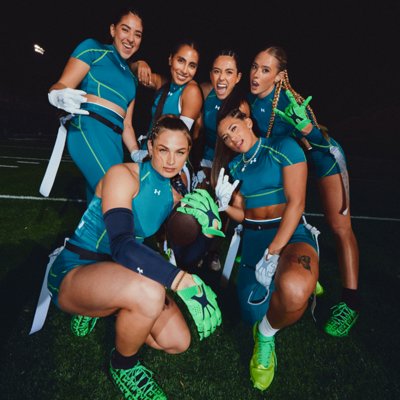
- No Tackling or Contact: There’s a 2-hand touch version of 7 on 7, where the defender must touch the offensive player with both hands below the neck to get them down, 1-hand version where the offensive player only has to be touched by 1 hand, or a flag league, where offensive players must wear flags around their belt and the defensive players then pull these flag to stop the play.
- No Offensive or Defensive Linemen: There’s no blocking because there’s no contact, which eliminates the need for linemen.
- No Pads or Hard Helmets: Some leagues might require soft shell head gear but because it’s a no-contact league, the need for protection is minimal.
- Duration: The game is typically two 20-minute halves with a break in the middle.
- No Running: The offense isn’t allowed to run the football. It’s a passing-only league.
- Positions: Each team generally has a quarterback, 5 receivers, and a center on offense and 7 defensive players who defend the pass. The center isn’t allowed to catch passes, and the defense isn’t allowed to rush the passer.
- Field Dimensions: The fields are usually between 40 and 50 yards long and 25 to 30 yards wide, and the end zones are typically 10 yards deep.
- Four-Second Rule: The quarterback has 4 seconds after the ball is snapped to throw a pass. If they don’t throw a pass, the play is ruled dead.
- Possessions: There aren’t kickoffs in 7 on 7. Instead, the offense starts its possession on the 40-yard line. A team has 3 possessions to get a first down. They can get a first down after crossing the 25 and the 10, which means there are at most only 2 first downs on a scoring possession. If a team fails to get a first down, their opponent gets the ball at the 40.
- Scoring: A touchdown is worth 6 points. Teams can opt for a 1-point conversion from the 5-yard line and 2-point conversion from the 10. There aren’t field goals or safeties. Some leagues count interceptions as 3 points and defensive stops on possessions as 2 points.
Some high school associations have recognized 7 on 7 as a sanctioned sport. It’s a great sport for smaller schools that might not have the resources to field a regular football team. Tackle football requires large amounts of resources that include a deep pool of players, equipment for kids like pads and helmets, and a regulation-size football field with bleachers. A 7 on 7 roster could have as few as 10 players on it. 7 on 7 is also a good way for regular high school football teams to stay sharp in the offseason. Wide receivers can work on route running and pass catching and quarterbacks can work on their accuracy and timing. Defensive players can work on their pass coverage skills. It’s easy for kids to play in a formal setting, like a league, or on their own. All you need is a football and some empty space, where you can mark the first downs and end zone.
7 on 7 Strategy
Creating your own offensive strategy can be one of the more exciting parts of building a successful 7 on 7 team. It’s a quick-paced game that is designed to be high scoring. It’s a good idea to create a playbook for the passing routes you’re using. Below are some concepts used for a 7 on 7 offense.
- Vertical Routes: These are pass plays intended to stretch the defense. Since you have 5 receivers, you can have 1 or 2 running deep routes (over 15 yards) on every play.
- Post Routes: Your fastest receiver or receivers run straight down the field and try to beat the defenders.
- Crossing Routes: These are usually plays where receivers who line up on the opposite side of the line of scrimmage run a route where they cross over the middle of the field.
The passing plays in 7 on 7 require quick reads by the quarterback. There should be multiple options on each play for the quarterback.
What to Wear & Bring
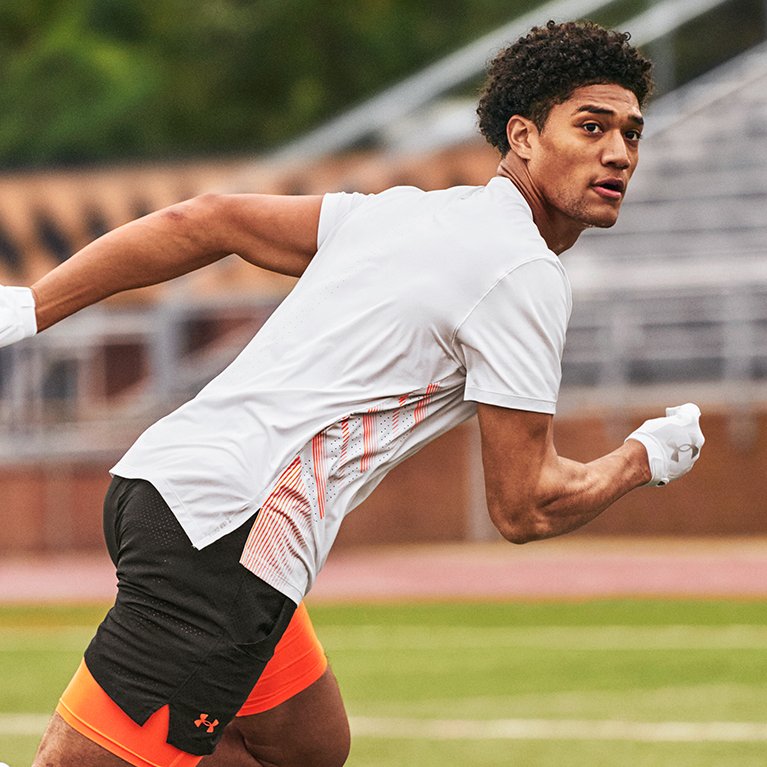
7 on 7 uniforms should be comfortable and lightweight since there’s no physical contact. Since 7 on 7 is usually played in warmer months or indoors, most players wear shorts and a jersey. Below are some clothing and gear options for 7 on 7.
- Pants/Shorts: Some players opt for a pair of compression shorts underneath a lightweight, moisture-wicking pair of shorts or pants.
- Cleats : A pair of low-cut cleats for the wide receivers and mid-sized cleats for the quarterback are good choices for 7 on 7 because of its quick pace. If you play outside on real grass, you might want to use molded cleats, which are designed to give you more traction. Detachable cleats may be better suited for indoors. They allow you to change the cleat sizes based on the field surface.
- Belt: If you’re playing in a 7 on 7 flag league, you need a waist-mounted belt that can have flags attached to it.
- Socks: A pair of moisture-wicking socks that are well ventilated are helpful to keep your feet from overheating.
- Water Bottle :You will need a lightweight, durable water bottle to help keep you hydrated.
- Extra Shirts, Pants/Shorts & Socks: Always carry extra essential gear in case something happens to the first pair you bring.
- Snacks: You might want to bring some easy to transport snacks that can give you a quick boost of energy, like nuts and nutrition bars.
- Gloves: A pair of grippy gloves can help you catch the football.
The versatility of 7 on 7 is one of its strongest qualities. Kids can get introduced to football concepts as early as kindergarten and then move into tackle football as they get older or just enjoy 7 on 7 recreationally.