
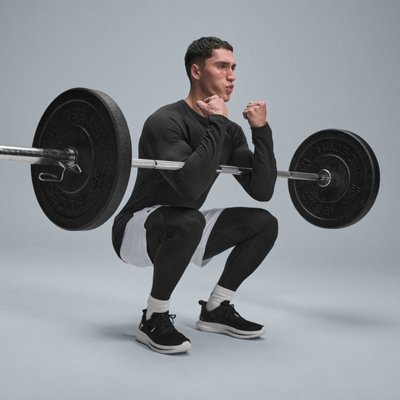




The Ultimate Guide to Buying the Right HIIT Shoes
You wouldn’t wear metal baseball cleats to a basketball game, or fishing sandals on a rocky, bumpy trail run. Between burpees, box jumps, push-ups, and sprints, you’ll need a shoe that’ll support the constant dynamic movements you’ll be putting your body through. Each shoe, cleat, boot, sandal—you name it—has a reason they’re designed. That’s to help you stay comfortable in a specific area. Training shoes for HIIT are in the same bucket. Make every rep count with shoes built for HIIT. Here’s what you need to know when looking for your next pair. Always check with your doctor before beginning any new exercise program.

Key Features to Consider When Buying HIIT Shoes
Some athletes will assume that, just because you might do some cardio and running throughout a HIIT workout, that running shoes are going to support you just as fine as a training shoe. That’s just not the case. Training shoes are specifically designed to keep your feet:
Supported and explosive through movements like jumping and dashing.
Soft with cushioning that’s made to absorb energy through ground contact and return it to push you forward.
Stable when you’re moving laterally and multi-directionally. They’ll do this by having things like rubber outsoles for added traction when you move.
Versatile. These are training shoes that’re supposed to perform through multiple training types, from cross training and weightlifting, to aerobics and HIIT.
Cool throughout your toughest workouts. When it comes to HIIT workouts, your heartrate gets tested early and often. You’ll sweat and then sweat some more. With the right training shoes, your feet will stay cool and dry thanks to plenty of ventilation throughout the uppers.
There’s a big difference between what you’re getting from a training shoe compared to a running shoe. Sure, you’re going to want a running shoe that's going to be lightweight, durable, and cushioned through a workout (the same kind of qualities you want in a training shoe). But, they’re built to help keep you steady throughout a forward motion, lacking the stability needed to move laterally effectively. They’re also a bit more flexible and lighter than a training shoe, which can affect the support you’re looking for on heavier lifts.
Sizing and Fit Tips
You want your HIIT shoes to fit snug around your heel and midfoot, but not too tight as to where the top of your foot is suffocating. Your shoes should fit comfortably where you can move around and have them secure without feeling like they’re too tight. When it comes to sizing, every shoe is unique. Some training shoes from a brand might run a bit differently size-wise than their running shoes, for example. You might also prefer to have a different toe box width in your training shoes, too. Tips for this? Simple. This one might sound a bit silly, but try on a pair of shoes in the afternoon since your feet swell during the day. This lets you get a fit when your feet are at their largest. Make sure you’ve got enough space, too, as there should be a little space between the end of your longest toe and the end of the shoe. You should be able to wiggle your toes inside them without causing the rest of the shoe to move.
As mentioned before in terms of width, some athletes look for a wider toe box to give them a little bit more space if you naturally have wide feet. In the case of training shoes, make sure they fit comfortably around the widest part of your foot. Narrow shoes can hurt your arches if you have wide feet. But, if your shoes are too wide, your foot can slip around and can cause blisters, a reduction in balance, and uncomfortableness.
When you’re trying your shoes on, wear yourself some gym socks. They should be the same ones you wear when you work out, and not a pair of casual dress socks, for example. This helps give you the most honest fit you’ll get. And, if space allows for it, take them for a little bit of a spin. Try some of the basic movements you’ll be doing (like squats, lunges, etc.) when going through a HIIT workout and see how they feel.
When to Replace Your HIIT Shoes
The reality is that your favorite HIIT shoes aren’t going to last forever. Support will eventually slow down throughout you wearing them. Traction will fade, cushioning will flatten, and discomfort, pain, and potential injury can come amuck. Here’s some signs to look out for when you should consider investing in a new pair of training shoes:
Wear and tear: If you notice any visible signs of wear and tear on the soles, uppers, or midsoles of your shoes, it's a clear indication that they're nearing the end of their lifespan. Check for holes, tears, or cracks, and pay attention to areas that feel overly soft or squishy.
Reduced performance: If your performance is gradually dropping, an old pair of shoes might be the problem. As shoes wear down, they lose their ability to absorb shock and provide stability, which can impact your performance and technique.
Mileage: If you've been using your shoes for a while, it's a good idea to keep track of the mileage. As a general rule of thumb, most training shoes will last between 300-500 miles before needing to be replaced. If you're not sure how many miles you've put on your shoes, you can estimate based on how often you use them and the duration of your workouts.
Take care of your HIIT shoes like any other piece of gear: wipe them down, let them dry out between sessions, and swap them when the cushioning flattens or the grip is slick. Do that and they’ll keep doing their job—steady support, reliable shock absorption—so you can do yours. A solid pair is worth it.